
Quarterly Resiliency Forecast-Fall 2026
Drought: The Sleeper Crisis
Editor’s Note: This quarter’s Resiliency Forecast is written by our 2026 intern, Brianna Curry. One of my favorite things about TRI’s internship program is the perspective our interns bring to our work, and Brianna is no exception. A former British Royal Navy Lieutenant, Brianna brings a fascinating mix of military intelligence, crisis leadership, and international experience to our team. As she transitions into civilian emergency management, we’ve had the opportunity to learn from her just as much as she has learned from us. I’m especially pleased to share Brianna’s perspective in this quarter’s newsletter and give our readers a chance to get to know one of the newest members of the TRI team!- Andrea
Now that the leaves are beginning to fall and we're settling into autumn, for some states, it feels as though wildfire risk may be fading as a pressing emergency, replaced by powerful hurricanes and winter storms on the horizon. But for our Fall newsletter, TRI wanted to take a moment to look back on this past summer and offer a slightly different perspective by turning to Europe.
The UK is back to its characteristic grey skies and drizzle; however, that wasn't the picture just a few short weeks ago. Wildfires had scorched the landscape brown, leaving the country looking as though it had borrowed a season from California. These unprecedented fires were the consequence of systems built on assumptions about a climate that is now being rapidly outgrown by unpredictable, shifting weather patterns. This past summer, those assumptions broke in real time, not only in the UK but across Europe, including Spain, France, Italy and Portugal.
The spring of 2026 was already the warmest on record for England and Wales. By mid-July, the UK had recorded more days above 86°F than in all of 1976, the country's benchmark heatwave-and-drought summer. The season ended with 33. July then delivered England's driest month since rainfall records began in 1836, with just 6.5mm (0.25 inches) of rain, roughly what Las Vegas, one of the driest cities in America, receives in an average month. Five separate heatwaves struck across the season: first in late May, again in late June, twice in July, and most recently in mid-August. Together, they made 2026 officially the UK's hottest summer on record. The June heatwave alone triggered the Met Office's first red extreme-heat warning of the year and was linked to an estimated 2,877 heat-associated deaths in England.
The UK was experiencing a sleeper drought: a drought serious enough to prime the landscape to burn, but slow-moving and unannounced enough that it is rarely treated as an emergency until something more visible creates one. The consequences were devastating to watch: forests and land engulfed in flames, with the British Prime Minister calling the UK a "tinderbox" at an emergency COBRA (Cabinet Office Briefing Room) meeting in August. By mid-August, fire services in England and Wales had responded to 1,132 wildfires, and the burned area was already larger than Washington, D.C. That was roughly three times the annual average of the previous five years, with more than four months of the season still to run, and it put real strain on the UK's equipment, personnel, and budgets.
Back on our West Coast, for decades, California managed wildfire risk in pieces, much as the UK tracks drought and wildfire today: closely linked risks, watched by separate institutions. Wildfires were largely treated as a wildland problem threatening forests and rural communities, while utility companies, which had the potential to spark fires, were overseen by other agencies focused primarily on power outages and service reliability, often without weighing the ignition risk posed by their equipment. Both were part of the same wildfire problem, yet they were overseen as if they were unrelated. That separation held until the 2017 Napa and Sonoma fires, when it became evident that under certain conditions (such as sleeper droughts), utility equipment failures could ignite fires that destroyed entire towns. It was a stark reminder that the existing oversight mechanisms were no longer adequate, and that agencies would need to coordinate far more closely.
California's legislature did not hesitate to respond. Senate Bill 901, signed in September 2018, required every electric utility in the state to file an annual Wildfire Mitigation Plan with regulators, backed by real financial and legal consequences. Before this law, wildfire mitigation was a judgment call. The timing proved sobering: within weeks, the Camp Fire ignited near Pulga, California, after a worn metal hook on a utility transmission tower failed. The hook had been supporting an energized high-voltage line, which fell and struck the tower, showering molten metal onto the dry vegetation below. The Camp Fire became the deadliest and most destructive wildfire in California's history: 85 deaths, nearly 19,000 structures destroyed, and an estimated $16.5 billion in economic damage, a cost that helped drive the utility into bankruptcy.
We recognize that UK wildfires differ from California's: British fires mostly burn heath, moorland, gorse and grassland, and rarely match the speed and intensity of California's wind-driven blazes. But the comparison isn't about identical fires; it's about similar gaps in how the risk is owned, monitored, and planned for before the fire arrives. The UK has not yet had its SB 901 moment. At present, there is no equivalent statutory requirement for utilities or major landowners to file a public, reviewable wildfire mitigation plan that accounts for drought conditions. Rather, what exists is good practice and goodwill, a position akin to California's before 2017.
That gap isn't just an outside observation. As reported by the Moorland Association, a civil servant working in UK environmental policy described the country's wildfire governance as roughly "30 years behind" the model used for flooding, which has a clear command structure and dedicated funding. No single department owns the UK wildfire strategy; responsibility is split between Natural England, the Fire and Rescue Services, and the Forestry Commission, none of which coordinates the entire picture. The consequences of the gap are already visible in the data: the National Risk Register's official worst-case wildfire estimate is "tens of millions" of pounds, while the Moorland Association, an industry body representing moorland owners, put the actual cost of 2025's wildfires alone at more than £460 million.
What We See Before the Crisis
TRI has spent years helping organizations close this exact gap through hazard mitigation, business continuity, emergency planning, and after-action work across the country. The cost of getting it wrong is not only financial; it can be measured in lives lost, ecosystems damaged, and communities facing years of recovery.
Our work examining major wildfire events has reinforced the connection between drought and fire. In one recent example, vegetation grew rapidly during two unusually wet years, only to dry out during an extended period with virtually no measurable rainfall. The drought itself was not the disaster that captured attention. It was the condition quietly developing beneath the surface, increasing the consequences when the visible disaster arrived.
Across emergency management and continuity work, three patterns repeatedly emerge:
1. Severity is measured hazard by hazard, rather than cumulatively. Heat, rainfall, drought, and wildfire conditions are often monitored independently. But emergencies rarely respect those organizational boundaries. By the time multiple indicators converge into a full-scale response, organizations may already be operating reactively.
2. The visible consequence becomes “the event,” while the conditions that made it possible are easily forgotten. A devastating wildfire season will be remembered for the fires themselves, not necessarily for the months of drought, extreme temperatures, changing vegetation, or other conditions that increased the risk. Plans need to prepare organizations not only for the visible hazard, but also for the possibility that the assumptions underlying those plans may no longer hold true.
3. Where strong coordination already exists, response is more likely to hold under pressure; where it does not, the cracks quickly become visible. After-action work consistently reinforces the value of relationships established before an emergency. Coordination built during routine operations becomes particularly important when multiple hazards, agencies, and operational demands converge.
From Awareness to Action
For organizations reading this, the takeaway is twofold: Plan and Partner Up.
Plan: Build continuity and emergency plans that recognize slow-building hazards such as drought as potential triggers, with clear ownership and escalation thresholds. Identify which critical functions must continue during the first 24 to 72 hours of a disruption, and then test those assumptions through exercises. A good tabletop exercise should not simply validate the plan; it should deliberately challenge it. Start with the hazard, dependency, or condition your organization has always assumed would not apply to you.
Partner Up: Look both internally and externally. Internally, bring together the teams that each hold a different part of the risk picture, and identify backups for key roles so the plan can still function when someone is unavailable. Externally, build the relationships your organization will depend on before you need them. Connect with local emergency management, fire, law enforcement, utilities, community organizations, and other partners. Understand what they may need from you and what your organization may be able to contribute, whether that is space, equipment, personnel, information, or other resources. Sharing data, capacity, and lessons learned can reduce duplication and strengthen the entire community’s ability to respond.
The strongest emergency managers may not be the ones who wait for their own worst day to learn these lessons. They are often the ones willing to learn from someone else’s first.
References
BusinessGreen, 'Number of Wildfires in England and Wales in 2026 Surpasses Last Year's Total' (BusinessGreen, August 20, 2026) https://www.businessgreen.com/news/4534615/wildfires-england-wales-2026-surpasses-last-total accessed September 27, 2026
California Department of Forestry and Fire Protection, 'Tubbs Fire (Central LNU Complex) Incident Record' (CAL FIRE, 2017) https://www.fire.ca.gov/incidents/2017/10/8/tubbs-fire-central-lnu-complex/ accessed September 27, 2026
Euronews, 'Wildfires in Europe: Is 2026 Already the Worst Year on Record?' (Euronews, August 13, 2026) https://www.euronews.com/2026/08/13/wildfires-in-europe-is-2026-already-the-worst-year-on-record accessed September 27, 2026
European Forest Fire Information System, 'Annual Statistics for United Kingdom' (Copernicus Emergency Management Service) https://forest-fire.emergency.copernicus.eu/apps/effis.statistics/estimates/GBR accessed September 27, 2026
KQED, 'What You Need to Know About PG&E's State-Mandated Wildfire Mitigation Plan' (KQED) https://www.kqed.org/news/11750455/what-you-need-to-know-about-pges-state-mandated-wildfire-mitigation-plan accessed September 27, 2026
Los Angeles Fire Department, 'Palisades Fire After-Action Review Report — Fact Sheet' (LAFD, 2026) https://lafd.org/sites/default/files/pdf_files/AARR_Fact_Sheet.pdf accessed September 27, 2026
Met Office, 'Historic July Sees Record Dryness, Unprecedented Sunshine and Exceptional Warmth' (Met Office, 2026) https://www.metoffice.gov.uk/about-us/news-and-media/media-centre/weather-and-climate-news/2026/historic-july-sees-record-dryness-unprecedented-sunshine-and-exceptional-warmth accessed September 27, 2026
Met Office, 'Summer 2026 So Far: A Look at the Season at the Halfway Point' (Met Office, 2026) https://www.metoffice.gov.uk/blog/2026/summer-2026-so-far-a-look-at-the-season-at-the-halfway-point- accessed September 27, 2026
Met Office, 'UK Heatwaves: How the Records Tell a Changing Story' (Met Office, 2026) https://www.metoffice.gov.uk/blog/2026/uk-heatwaves-how-the-records-tell-a-changing-story accessed September 27, 2026
Moorland Association, 'UK Wildfire Response Is "30 Years Behind" — And Firefighters Are Paying the Price' (Moorland Association, 27 November 2025) https://www.moorlandassociation.org/post/uk-wildfire-response-is-30-years-behind-and-firefighters-are-paying-the-price accessed September 27 2026
National Fire Chiefs Council, 'New Wildfire Record Sparks Urgent Call for Fire Service Investment' (NFCC, September 5, 2025) https://nfcc.org.uk/new-wildfire-record-sparks-urgent-call-for-fire-service-investment/ accessed September 27, 2026
National Fire Chiefs Council, 'Wildfire Update: Continued Vigilance Needed' (NFCC, August 17, 2026) https://nfcc.org.uk/wildfire-update-continued-vigilance-needed/ accessed September 27, 2026
National Weather Service Las Vegas, 'Precipitation Overview' (NWS) https://www.weather.gov/media/vef/Climate/Las%20Vegas%20Climate%20Book%20Temp/Precipitation%20Overview.pdf accessed September 27, 2026
The TRI Influence

Read GlobalMindEd’s interview with Andrea. She reflects on how supporting Hurricane Katrina recovery shaped her personally and professionally, the experiences that inspired her to establish TRI, and her belief that resilience can be learned, strengthened, and shared.
Learn about the Resiliency Institute’s Summer Resiliency Academy.
Watch the inaugural episode of Profiles in Resiliency, where Andrea sits down with Michelle Wynn and Debbie Malone of the Northwest Arkansas Chapter of Child Care Aware to explore resilience through the eyes of those who care for our youngest community members.
Read Andrea’s tips that she provided to USA Today around the extensive planning required to safely execute one of the year's highest-profile events, the wedding of global music icon Taylor Swift and NFL star Travis Kelce.
Recent Blog Posts
July 2026: You Can't PowerPoint Your Way to Preparedness
August 2026: When Crisis Hits: You’re Thinking About the Business. Your Employees Are Thinking About Home.
What’s New at The Resiliency Institute
It has been a busy quarter for TRI’s nonprofit arm, The Resiliency Institute, with exciting progress across all three of our mission pillars: Intellectual Growth, Financial Empowerment, and Inspiring Resiliency.
Pillar I: Intellectual Growth
Our July Virtual Resiliency Academy was our highest-rated Academy yet! We welcomed 20 attendees from across the resiliency profession, with approximately one-third participating through scholarships. We were also grateful to welcome AshBritt as an Academy sponsor with a generous $1,000 contribution. Together, registration and sponsorship generated approximately $2,500 to support the Institute and help us continue expanding access to resiliency education.
Pillar II: Financial Empowerment
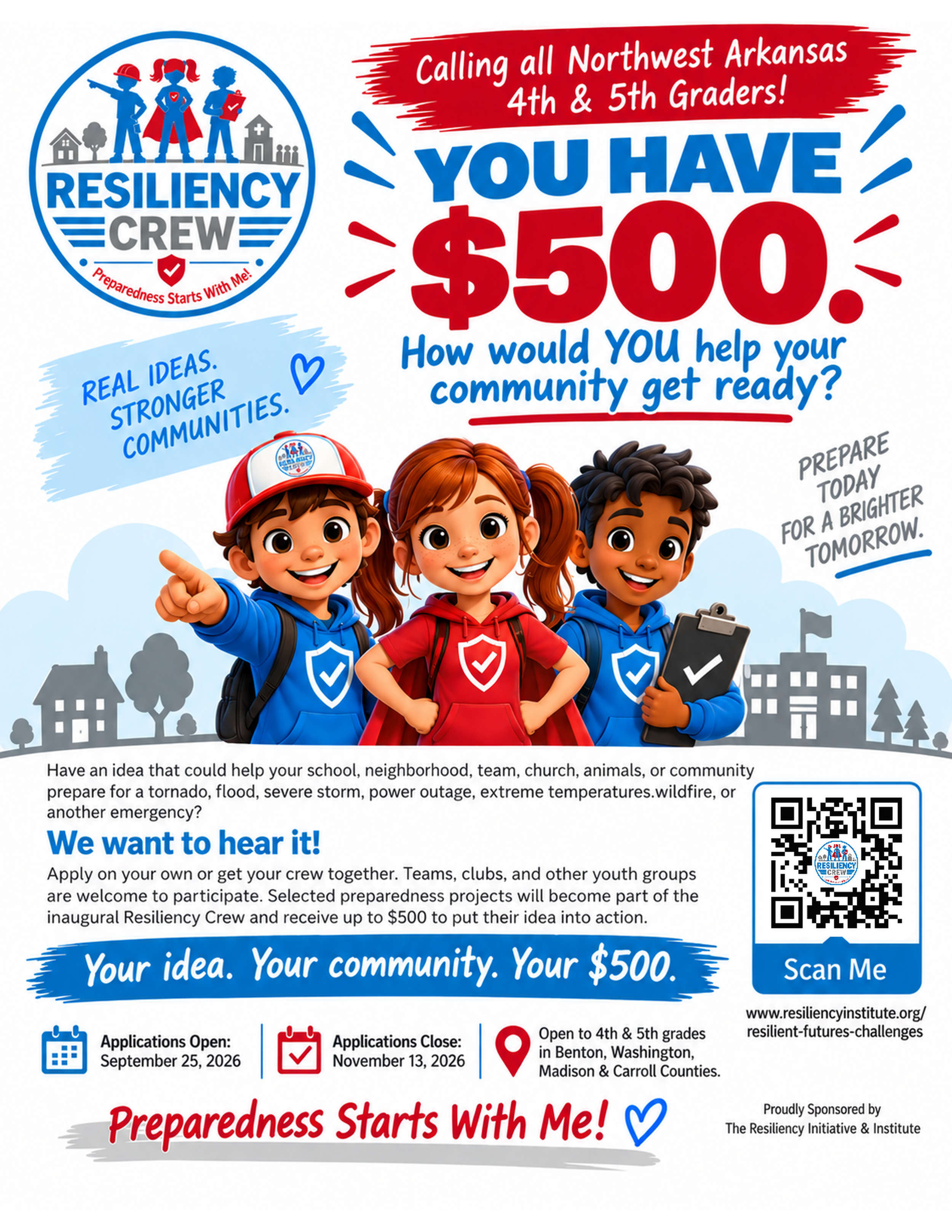
In September, we launched our first Resilient Futures Challenge: Resiliency Crew, a new pilot program putting preparedness ideas and the resources to make them happen directly into the hands of young people.
The challenge invites 4th and 5th-graders across Northwest Arkansas to identify a preparedness need in their school, neighborhood, or community and tell us how they would solve it. Selected projects can receive up to $500 to turn those ideas into action. Our goal is simple: show young people that they do not have to wait until they grow up to make their communities more resilient.
Pillar III: Inspiring Resiliency
September also marked the launch of Profiles in Resiliency, the Institute’s new YouTube series sharing real stories of strength, survival, and recovery. Our first episode featured representatives from Child Care Aware of Northwest Arkansas, who shared their experiences supporting children, families, and childcare providers during crisis and recovery.
About TRI
At TRI, we’re more than consultants; we’re partners in helping communities and organizations thrive through crisis. As a certified women-owned and run small business enterprise, we take pride in being a boutique firm with a personal touch, delivering high-impact, hands-on support tailored to the unique needs of every client we serve.
For communities, we focus on what matters most: hazard mitigation, evacuation planning, continuity of operations, and dynamic training and exercises that build real-world readiness. For organizations, our strength lies in business continuity planning and simulations that keep operations steady, even in the most uncertain times.
What sets us apart is the depth of our experience. Our leadership team brings decades of firsthand expertise from FEMA, Fortune 500 corporations, the military, local governments, and the nonprofit sector. We don’t just check boxes, we empower people to lead with confidence when it matters most.
To request a free consultation, email info@theresiliencyinitiative.com or call +1 (877) TRI-7191
