
Quarterly Resiliency Forecast-Spring 2026
When the Plan Fails, the Process Leads
Back in December, TRI’s Annual Resiliency Forecast reported that 2026 would not be defined by single, isolated events, but by layered, overlapping disruptions that would test organizations in new ways. We anticipated increasing pressure from severe weather, ongoing infrastructure fragility, and a growing dependence on systems that are not as resilient as we assume. Just a few months into the year, that forecast is already proving true. Events are not occurring in sequence; they’re compounding. Teams are navigating multiple disruptions at once, often while still recovering from the last.
What we’re seeing now, more clearly than ever, is that the issue isn’t just the volume of disruption; it’s the gap between planning and execution. Organizations have plans. Many of them are thoughtful, detailed, and well-intended. But in a real event, when information is incomplete, systems are degraded, and decision-making needs to happen quickly, those plans often don’t translate. People hesitate. Roles become unclear. Communication slows down. And valuable time is lost trying to “figure out the plan” instead of moving forward.
That’s where the shift needs to happen.
We have to move from a reliance on plans to a reliance on processes.
A plan is static. It’s built for a specific scenario, at a specific point in time. A process is dynamic. It gives your team a way to operate when the situation doesn’t match what was expected, which, increasingly, is always. A strong process creates alignment under pressure. It reduces decision friction. It allows teams to act with confidence even when conditions are uncertain or rapidly changing.
At its core, a process answers a few critical questions:
Who is responsible for what?
How do we communicate and share information?
How are decisions made and by whom? And,
How do we continue our most critical functions, even in a degraded environment?
Without those answers being clear and understood before an event, even the best plan will fall short.
So what does a strong, actionable process actually look like?
Defined roles with built-in redundancy: It’s not enough to assign roles—you need to assume that someone will be unavailable. Who is the backup? And do they know it’s their responsibility? Clarity here eliminates hesitation when time matters most.
Pre-established communication pathways, including failure points: Most organizations plan for communication in ideal conditions. Few plan for communication when systems fail. Your process should include primary, secondary, and even tertiary methods, and your team should be familiar with all of them.
A shared understanding of decision-making thresholds: When does a situation escalate? Who has the authority to make which decisions? If everything requires consensus or approval, you will slow down your response. A good process empowers action at the right levels.
Clear identification of critical functions and what “continuity” actually means: Not everything can or should continue during a disruption. What are the essential services or operations that must be maintained in the first 24, 48, 72 hours? And what does “good enough” look like in a constrained environment?
Practice that builds muscle memory, not just awareness: The goal isn’t to walk through a perfect scenario. It’s to help your team experience decision-making under pressure, understand how the process works, and build confidence in executing it.
The organizations that are navigating disruption most effectively right now are not the ones with the most comprehensive plans on paper. They’re the ones whose teams understand how to operate when things go off script. They’ve simplified complexity into something usable. They’ve built processes that people can actually follow.
Want a simple way to start? Create a process that your team can carry with them. Literally.
We often encourage organizations to distill their emergency communication process down to a single, wallet-sized card. Not a binder. Not a 40-page plan. Something clear, accessible, and usable under pressure.
Here’s a link to a simple template to get you started.
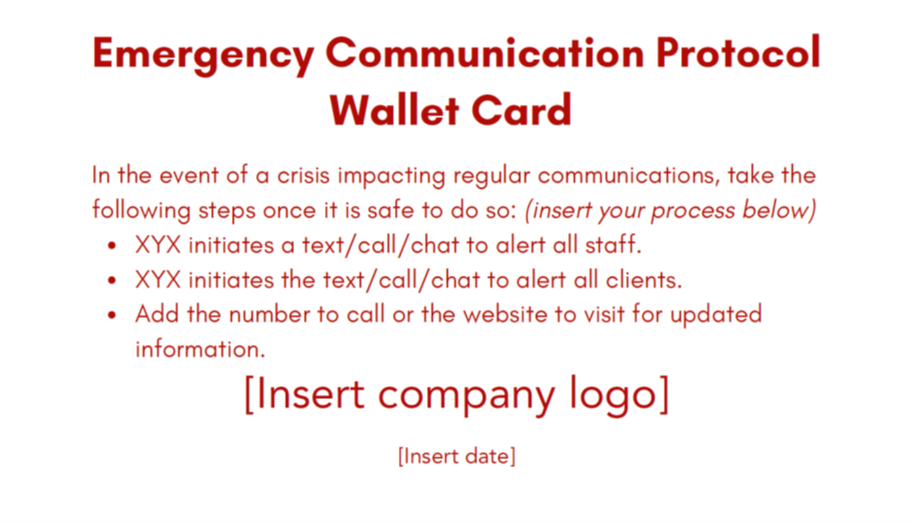
Fill it out. Print it. Cut it down. Laminate it, if you can. But most importantly, make sure your team understands it. Because in a real event, people won’t reach for a plan. They’ll rely on what they know. And a simple, well-understood process, one they can carry with them, can make all the difference.
Sneak Peek: Profiles in Resiliency YouTube Series

We’re excited to share a first look at something very close to our hearts.
Profiles in Resiliency: Stories of Hope and Tenacity. Uncut from America’s Heartland is an upcoming TRI YouTube series featuring real, unfiltered conversations about what it truly means to be resilient. And to kick it off, we’ve released a special promo video that shares Andrea’s story, offering a personal glimpse into the experiences that have shaped TRI’s work and TRI’s mission.
This passion project brings friends, colleagues, and leaders to the TRI couch to share honest stories of grit, perseverance, and rising above challenges. The kind of stories that remind us why resilience matters.
Watch the promo and subscribe to be the first to see the full series here.
What’s New at The Resiliency Institute
We are excited to share an important update for TRI’s Foundation, The Resiliency Institute. TRI’s award-winning Resiliency Academy has shifted under the Institute’s banner.
The Academy is designed to deliver practical, real-world crisis management training. Participants also receive 16 continuing education credits, applicable toward professional certifications, including ASIS, IAEM (AEM and CEM), and DRII recertifications, helping professionals not only build capability, but maintain and advance their credentials.
By offering the Academy under a 501(c)(3) nonprofit, we are able to significantly reduce costs and expand access. This included providing three scholarships to participants who may not otherwise have had the opportunity to attend. It’s a small but meaningful step toward ensuring that high-quality resiliency training is not limited by budget constraints.
This effort would not have been possible without the TRI team and our guest lecturers, who generously donated their time and expertise to make the Academy a reality. Their commitment reflects what resilience is truly about: sharing knowledge, supporting others, and building stronger communities together.
Recent Blog Posts
January 2026: The Day Andy’s Cow Patty Palace Almost Closed…
February 2026: Level Up Your Resilience: Professional Development That Pays Off.
Philanthropy in Action
At TRI, we believe philanthropy bolsters a community’s resilience at the micro and macro levels. This fuels our steadfast commitment to supporting philanthropic endeavors in the US and abroad.
An update from the Resilient Foundation (TRF), Palghar, India. 2026 marks the fourth year that TRI has partnered with TRF to offer resilience education and training programs to rural and tribal locations.
Expanding Preparedness Through Schools and Communities: TRF has secured approval to conduct training and assessments across 58 tribal schools, laying the groundwork for a more systemic approach to school safety. At the same time, hands-on preparedness training in coastal communities is strengthening real-world response skills, from water rescue to first aid. These efforts are building confidence at the local level, ensuring that when disruptions occur, communities are not waiting for help but are ready to act.
Building Climate-Resilient Livelihoods Through Bamboo: TRF is helping shift how communities think about resilience, starting with what they already have. This quarter, a comprehensive bamboo survey reached 718 farmers and mapped more than 10,000 bamboo clumps, creating a data-driven foundation for sustainable livelihoods. What’s powerful here is the shift from theory to opportunity. Bamboo is no longer just a resource; it’s becoming a pathway to income. With early-stage craft training already engaging women and youth, we’re seeing strong interest in turning local materials into marketable products and long-term economic stability.
Connecting Water Security to Long-Term Resilience: Access to water remains one of the most critical, and often overlooked, components of resilience. Through community mobilization efforts, 180 households applied for support for rainwater harvesting under the Jaltara approach, thereby strengthening household-level water access. What makes this work especially impactful is its ability to connect across systems. Reliable water access supports not just daily life but also enables new livelihood opportunities, such as bamboo cultivation, which requires consistent early-stage care. It’s a clear example of how resilience interventions are most effective when they are integrated, not siloed.
Supporting Animal Rescue in Siskiyou County, California. A little closer to home, we’re continuing our partnership with the Siskiyou County Humane Society to bring an emergency animal rescue trailer online, ensuring animals can be safely evacuated and cared for during disasters. What started as a concept is now becoming reality. The trailer has been designed and branded, including partnerships with organizations like the American Kennel Club’s Pet Disaster Relief program, and we’re proud to see TRI represented on the exterior as part of this collaborative effort.
The trailer is expected to be operational within the next couple of months, marking a significant step forward in local response capability. In disasters, animal evacuation is often a major barrier to human safety. People will delay leaving if they cannot bring their pets. This investment helps remove that barrier, supporting both animal welfare and overall community resilience.
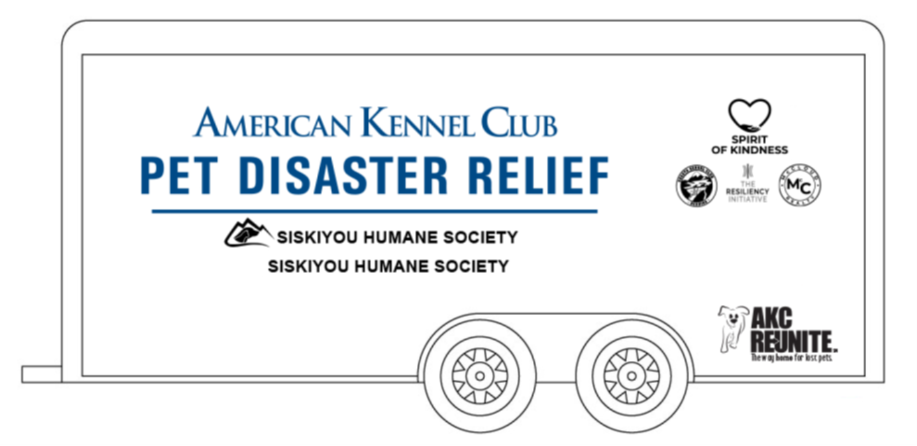
Artist mockup of the pet disaster relief trailer.
About TRI
At TRI, we’re more than consultants; we’re partners in helping communities and organizations thrive through crisis. As a certified women-owned and run small business enterprise, we take pride in being a boutique firm with a personal touch, delivering high-impact, hands-on support tailored to the unique needs of every client we serve.
For communities, we focus on what matters most: hazard mitigation, evacuation planning, continuity of operations, and dynamic training and exercises that build real-world readiness. For organizations, our strength lies in business continuity planning and simulations that keep operations steady, even in the most uncertain times.
What sets us apart is the depth of our experience. Our leadership team brings decades of firsthand expertise from FEMA, Fortune 500 corporations, the military, local governments, and the nonprofit sector. We don’t just check boxes, we empower people to lead with confidence when it matters most.
To request a free consultation, email info@theresiliencyinitiative.com or call +1 (877) TRI-7191
